
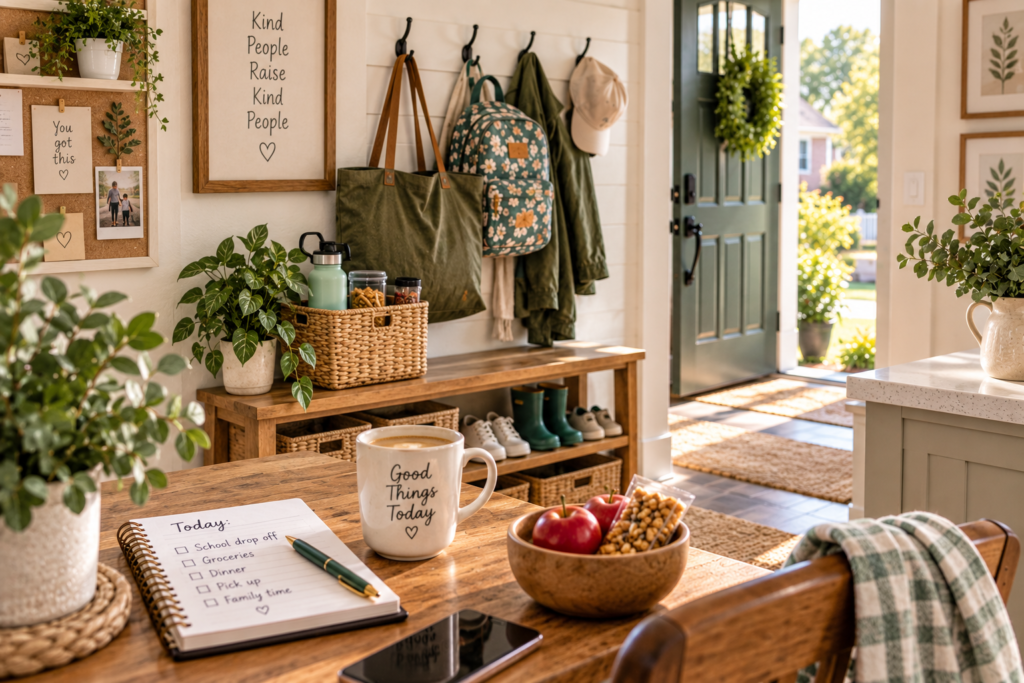
Some days, it feels like half of motherhood is remembering where everyone’s shoes are, finding the missing water bottle, cleaning up the same mess for the third time, and trying to get out the door with everything you actually need.
You don’t need a perfectly organized routine to make family life run a little smoother. Sometimes, one small change can eliminate an everyday frustration you’ve been dealing with for months. These simple mom hacks are all about creating shortcuts, reducing unnecessary steps, and making the busiest parts of your day a little easier.
Try the ideas that fit your family and skip the ones that don’t. The goal isn’t to create another list of things you should be doing—it’s to find a few little changes that genuinely make life easier.
1. Create a “Leaving the House” Station
If getting everyone out the door usually involves searching for shoes, backpacks, keys, water bottles, or something else that disappeared at the worst possible moment, create one designated spot for the things your family regularly needs when leaving home.
Your station can be as simple as a few hooks near the door, a basket for shoes, a small tray for keys, or a shelf for backpacks and bags. You don’t need a picture-perfect entryway or an expensive organization system. The goal is simply to make the things you reach for on the way out easy to find—and easy to put back when you come home.
THE HELPFUL EDIT TIP
Build your leaving-the-house station around what your family actually forgets. If someone is always running back for sunglasses, a jacket, or their water bottle, that item has earned a spot near the door.
2. Keep a Backup Essentials Kit in the Car
You don’t need to pack your entire house into the car to be prepared for everyday surprises. A small backup kit with a few essentials can save you from an unnecessary trip home—or an emergency stop at the store—when someone spills something, gets muddy, or needs an item you forgot to grab on the way out.
Think about the little things your family tends to need unexpectedly. A change of clothes for younger kids, wipes, a few shelf-stable snacks, bottled water, tissues, hair ties, or a spare reusable shopping bag can cover a surprising number of situations. Keep everything together in one small bin or bag so it doesn’t become another source of clutter in the car.
THE HELPFUL EDIT TIP
Build your car kit from the things you’ve actually wished you had—not from a giant checklist online. Every time you catch yourself thinking, “I wish I had ___ in the car,” add it to your kit.
3. Create a Grab-and-Go Snack Station
When someone asks for a snack while you’re already trying to make dinner, answer an email, or get everyone ready to leave, even a simple request can feel like one more thing on an already-full list. Creating one easy-to-reach snack station can make those little moments much simpler.
Choose a drawer, basket, or small section of the pantry for snacks that are already portioned and ready to grab. If your kids are old enough to choose their own snacks, keep a few parent-approved options within their reach. You can even create a small refrigerated snack area for things that need to stay cold. The goal isn’t to create a perfectly stocked snack bar—it’s to make the choices you already keep at home easier to access.
THE HELPFUL EDIT TIP
If you want kids to make more independent choices, make the choices you’re comfortable with the easiest ones to reach. A little independence for them can mean one less decision for you.
4. Prep Tomorrow’s Essentials Tonight
Mornings tend to feel more stressful when you’re trying to make decisions and find things while everyone is getting ready at the same time. Spending just a couple of minutes preparing the things that usually slow you down can make the next morning feel noticeably easier.
You might set out clothes, put backpacks by the door, refill water bottles, check that shoes are where they belong, or place anything that needs to leave the house beside your keys. You don’t need to prepare everything for the next day. Focus on the one or two things that are most likely to cause a last-minute scramble.
THE HELPFUL EDIT TIP
Pay attention to what makes you say, “Why are we always looking for this in the morning?” That’s probably the thing worth preparing the night before.
5. Keep a Donation Basket Going
Decluttering is much easier when you don’t have to turn it into an entire project. Instead of waiting until you have time to sort through closets and drawers, keep a designated basket or box somewhere convenient for things your family is ready to let go of.
When you notice a shirt that no longer fits, a toy nobody plays with, or a household item you don’t use anymore, put it directly into the donation basket instead of returning it to its usual spot. Once the basket is full, move it to your car and drop it off the next time you’re already near a donation center.
THE HELPFUL EDIT TIP
Make the donation basket easier to use than putting the item back. If donating something requires finding a box in the garage or starting a whole decluttering project, you’re much more likely to tell yourself, “I’ll deal with it later.”
6. Create a Home for Papers That Need Your Attention
Paper clutter becomes especially frustrating when important papers get mixed in with things you don’t actually need to keep. Instead of creating a complicated filing system for everything that enters your home, start by giving papers that require action one designated place.
Use a small basket, wall pocket, folder, or tray for anything you need to sign, pay, return, schedule, or respond to. School forms, permission slips, bills, appointment paperwork, and other time-sensitive papers can all go there. Once you’ve handled something, either file it if you truly need to keep it or recycle it so the pile doesn’t continue to grow.
THE HELPFUL EDIT TIP
Your action-paper spot is not permanent storage. If you’re waiting for something from a piece of paper, keep it there. If the paper is waiting for something from you, handle it and move it out.
7. Create a Keepsake Bin for the Papers You Want to Save
Not every paper cluttering the counter needs to be thrown away or acted on. Some things are worth keeping—kids’ artwork, special school projects, certificates, cards, handwritten notes, and other little pieces of life you may want to look back on someday.
Instead of feeling like you have to decide exactly how to preserve each item the moment it comes home, give keepsakes one designated place. A simple bin, file box, or portfolio for each child can become a temporary home for anything you might want to save. Then, once or twice a year, go through it and choose the pieces that feel meaningful enough to keep long-term.
THE HELPFUL EDIT TIP
You don’t have to decide whether something deserves a permanent place in the memory box the day it comes home. Give yourself a “keep for now” spot and make that decision later, when you’re not standing in the kitchen holding a finger painting while making dinner.
8. Make a “Future You” Basket
Some clutter isn’t waiting to be put away—it’s waiting to leave the house. Library books need to be returned, a store purchase needs to go back, something needs to be taken to school, or an item belongs to a friend or family member. Until then, those things tend to sit on counters, tables, or beside the front door while you try to remember where they need to go.
Give those items one designated basket or bin near the door. Whenever something needs to leave the house eventually, put it there. Before heading out, take a quick look inside to see whether anything in the basket is going where you’re already headed.
THE HELPFUL EDIT TIP
Don’t make your brain responsible for storing both the item and the reminder. Put the item somewhere you’ll naturally see it before leaving, and let the basket do the remembering for you.
9. Keep a Running “We’re Almost Out” List
Running out of something isn’t usually the frustrating part—it’s realizing you noticed it was getting low three days ago and completely forgot about it. Instead of relying on yourself to remember later, create one easy place to record household items the moment someone notices they’re almost gone.
Your list can live wherever your family is most likely to use it: a note on the refrigerator, a small whiteboard, a shared note on your phone, or directly inside the grocery list you already use. When someone opens the last roll of paper towels, notices there are only five diaper left, or sees the toothpaste getting low, add it immediately instead of trying to remember it the next time you shop.
THE HELPFUL EDIT TIP
The best shopping list is the one you can update the moment you notice something is running low. If you always have your phone nearby but never remember to check the refrigerator list, your phone is probably where the list belongs.
10. Stop Trying to Remember Everything
Moms carry an incredible number of little reminders throughout the day: schedule the appointment, sign the school form, order more socks, bring something for class tomorrow, return that package, text someone back, and somehow remember the birthday party next weekend. Trying to keep all of those thoughts in your head makes it much easier for something to slip through the cracks.
Choose one place to capture those thoughts as soon as they pop into your head. It could be a notes app, planner, small notebook, or digital task list. The specific tool matters less than consistently using the same place. When you think, “I need to remember to…” write it down and let yourself stop thinking about it for the moment.
THE HELPFUL EDIT TIP
Your brain is great at having ideas and noticing what needs attention. It doesn’t have to be the place you store every reminder. Write it down somewhere you trust, then give yourself permission to stop carrying it around in your head.
11. Create a Five-Minute Family Reset
When the house starts looking like everyone walked in, dropped their belongings, and moved on to the next thing, it can be tempting to wait until later and clean it all up yourself. Instead, try a five-minute family reset where everyone helps return a few things to where they belong.
Set a timer and give everyone simple, age-appropriate jobs. Younger kids might put toys into baskets or carry dirty clothes to the hamper, while older kids can put away shoes, clear cups from the living room, or reset their backpacks for the next day. Adults can tackle whatever needs attention too. The goal isn’t to clean the entire house—it’s to have everyone contribute to making the shared spaces a little easier to live in.
THE HELPFUL EDIT TIP
Don’t spend five minutes telling everyone exactly what to do while you clean around them. Give each person one simple responsibility they can learn to notice and handle on their own. The goal isn’t just a tidier room—it’s making the reset a shared responsibility.
12. Keep an “Upstairs/Downstairs” Basket
It’s easy to spend half the day carrying random things from one room to another—a stray sock needs to go upstairs, a toy belongs in a bedroom, or something from the bathroom somehow ended up in the living room. Instead of stopping what you’re doing every time you find something out of place, give those wandering items a temporary home.
Keep a small basket near the stairs or another convenient spot and place anything inside that belongs on the other floor. The next time you’re already heading that way, take the basket with you and put the items away. If your home is only one level, the same idea can work with a basket for things that need to be returned to bedrooms or another part of the house.
THE HELPFUL EDIT TIP
Don’t turn every misplaced item into its own errand. Group little tasks together and handle them when you’re already headed in that direction. One less unnecessary trip might not feel like much, but those interruptions add up throughout the day.
13. Keep a Few “Emergency Easy” Meals on Hand
Some days simply don’t go according to plan. An appointment runs late, someone needs extra attention, you forget to thaw the meat, or by dinnertime you just don’t have the energy to make what you originally planned. Having a few intentionally easy backup meals can take some of the pressure off those nights.
Choose a handful of meals your family will actually eat that require very little thought or preparation, then keep the ingredients on hand whenever possible. That might be frozen pizza with fruit or vegetables, quesadillas, pasta and sauce, sandwiches, breakfast for dinner, or another simple family favorite. These meals aren’t a failed dinner plan—they’re part of the plan.
THE HELPFUL EDIT TIP
Choose your backup meals before you need them. When everyone is hungry and you’re already exhausted, deciding what to make can feel harder than making it. Having two or three default options means one less decision at the end of a long day.
14. Create a Default for Repetitive Decisions
Not every everyday decision needs a brand-new answer. When you’re making dozens of little choices for yourself and your family throughout the day, creating a few reliable defaults can make routines feel much easier.
Think about the decisions you find yourself making over and over again. Maybe you keep two or three go-to breakfasts for busy mornings, have a default school-day hairstyle, choose one easy lunch when you don’t know what to pack, or keep a favorite gift idea for last-minute birthday parties. A default doesn’t mean you always have to choose the same thing—it simply gives you an easy answer when you don’t want to spend energy deciding.
THE HELPFUL EDIT TIP
If you regularly ask yourself the same question, consider giving yourself a default answer. You can always choose something different when you want to—but you don’t have to start from scratch every time.
15. Fix the Friction, Not Your Entire Routine
When part of your day consistently feels chaotic, it’s easy to assume you need a better routine, a new schedule, or a complete organization overhaul. But often, there’s one small point of friction making that part of the day harder than it needs to be.
Maybe mornings are stressful because shoes are always missing. Maybe getting out the door takes forever because water bottles aren’t ready. Maybe papers pile up because there isn’t an obvious place to put them. Instead of changing everything at once, identify the specific moment that keeps causing frustration and look for the smallest change that could make it easier.
THE HELPFUL EDIT TIP
When something repeatedly frustrates you, get curious before trying to get more organized. Ask, “What exactly is making this harder than it needs to be?” Sometimes fixing one tiny problem can make an entire routine feel easier.
Making everyday life easier doesn’t always require a brand-new routine or a perfectly organized home. Sometimes it’s a basket by the door, a backup dinner in the freezer, one place to write down reminders, or a five-minute reset that keeps tomorrow from feeling quite so overwhelming.
You don’t need to try all 15 of these ideas at once. Choose the one that solves a frustration you’re already experiencing and start there. The best mom hacks aren’t the ones that make life look effortless—they’re the ones that quietly remove a little stress from your day and give you more time and energy for the things that matter to you.
Looking for more ways to make everyday life a little easier? Explore more Mom Life ideas from The Helpful Edit.